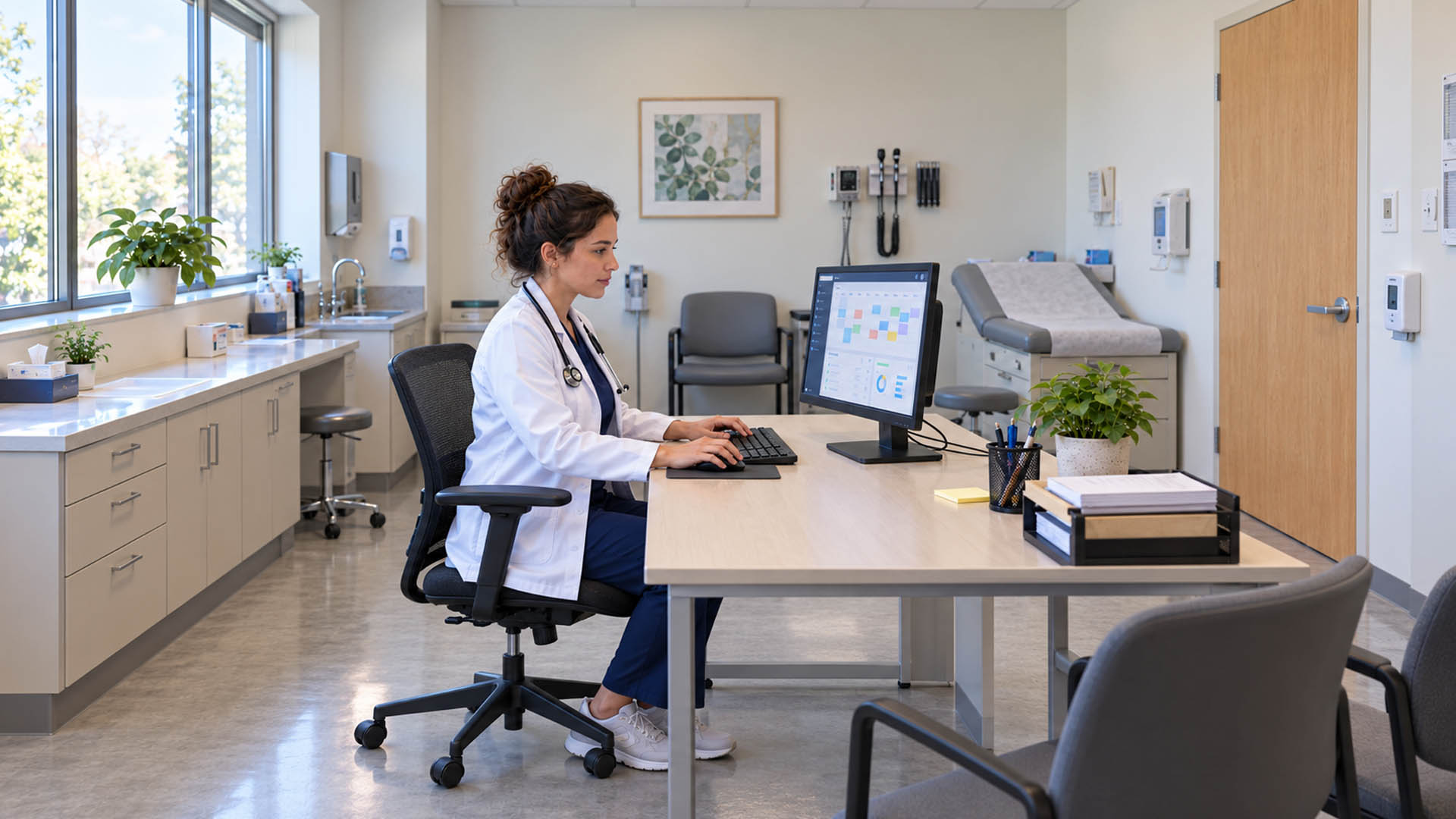
Most electronic health record systems force a clinic to change how it works. FiggHealth, a healthcare technology company based in Fort Lauderdale, takes the opposite approach: its Electronic Health Record is configured around the workflows a Florida health center already uses, with every screen approved by the facility before it is built. This article walks through the architecture of the FiggHealth EHR, its core modules from scheduling to revenue cycle, the reporting it produces, and the standards it is built to meet.
FORT LAUDERDALE, Florida, October 31, 2026
An electronic health record is the operating system of a clinic. It determines how a patient is registered, how an encounter is documented, how a charge becomes a claim and how a health center proves the quality of its care to the agencies that fund it. When the record fits the clinic, staff spend their time on patients. When it does not, they spend it on workarounds. FiggHealth designed its EHR for the second situation to disappear.
The challenge for Florida clinics
Florida’s outpatient care is delivered through an unusually diverse mix of organizations: community health centers serving multiple counties from several sites, rural clinics with a small staff wearing many hats, specialty practices, rehabilitation and behavioral health providers, and urban safety net facilities. Each operates under layered reporting obligations. Federally supported health centers must submit Uniform Data System (UDS) reports every year. Practices participating in Medicare quality programs report electronic clinical quality measures. Every provider must protect patient information under HIPAA and support secure electronic prescribing.
A generic, one size fits all record system rarely handles this combination well. Common complaints from Florida clinic administrators include separate calendars for in person and virtual visits, billing systems that do not talk to clinical documentation, reports that require manual spreadsheets to assemble, and vendor roadmaps that never reach the customizations a particular facility needs. The cost of these gaps is paid in staff overtime, delayed claims, denied reimbursement and clinician burnout.
What the FiggHealth EHR is
The FiggHealth Electronic Health Record is a centrally hosted, fully branded and custom configured EHR that connects all of a healthcare organization’s facilities on one network and serves every registered user, clinical and administrative. It reproduces the EHR functions a facility already relies on and adds the custom requirements the organization specifies, such as electronic prescriptions or telehealth mobile applications.
The defining feature of the implementation is approval before build. Every software screen and business workflow is reviewed and approved individually by the point person the health center appoints, before customization and delivery. The result is a record that mirrors established practices and protocols rather than replacing them, and one that supports future enhancement without disrupting daily operations.
FiggHealth states that the platform integrates with the National Library of Medicine systems, including MedlinePlus, the Unified Medical Language System (UMLS) and PubMed, so that clinical terminology, patient education content and literature references are available inside the record, and that it is built and audited against the standards health centers are measured by, including ONC Health IT certification criteria, MACRA quality reporting, HITRUST, Surescripts electronic prescribing connectivity and PCI DSS for payment handling.
Core modules and how they work
Patient management and registration
Patients and staff enter demographic information, identifiers required for state and federal reporting, insurance details and medical history. Because the record is central, a patient registered at one site is immediately known at every other site in the network, which eliminates duplicate charts across a multi county health center.
Scheduling
The EHR provides a single appointment calendar for both telehealth and physical visits. Staff can create, cancel or reschedule appointments, print daily schedules and mark non business days such as weekends and holidays. Automated appointment reminder SMS messages reduce no shows, a persistent problem for clinics serving patients with limited transportation.
Encounter workflow
An encounter begins when the patient is checked in. The module presents the day’s appointments, both virtual and in person, and guides the provider through a step by step process: check in, labs, medications, referring providers, check out, and, when needed, an emergency telehealth call. Evaluation and management coding support is built into the documentation flow so that the level of service is captured at the point of care.
Medical billing and enterprise revenue cycle
At the end of each encounter the provider selects the charges and associated diagnostic codes, reorders or corrects them, and marks the encounter Ready to Bill. Insurance plan and eligibility information is attached to the encounter. A dedicated billing portal then presents weekly, monthly and year to date status, daily financial activity and actionable prompts, including electronic remittance advice (ERA) received from payers and encounters still pending billing. Billing staff work from charge history and detail, payment plans, claim review and correction, and patient outstanding balances, with electronic claims, patient statements and follow up and denial management handled within the same system.
Care coordination and correspondence
The EHR generates and prints patient letters so that clinic personnel can confirm patients receive appropriate health information. It also supports secure offline messaging between users, with a complete audit trail of every communication. A nurse can route a medication dosage question to a provider, a front desk clerk can leave a note for the next shift to mail lab results after confirmation, and nothing is lost in the pace of a busy clinic day.
Wound care management
Wound care is a specific clinical need in a state with a large older population and high rates of diabetes. The module records and retrieves assessments such as wound type (burn, surgical incision or pressure area), tissue loss, wound bed appearance and measurements, supports chronic and acute wound management records, and stores images with provider notes and observations attached to each image.
Reporting and dashboards
Clinic personnel can run metrics reports that quantify the work of the clinic, including time based counts of patients seen, reasons for visits and the status of care. Two report types are especially important for Florida health centers: UDS population health reporting and electronic clinical quality measures. Dashboards are individualized by role and access rights, with separate physician and staff dashboards whose contents are finalized by the facility’s point persons.
Document management, secure messaging and portals
Patient and staff portals, document management and secure messaging complete the module set, giving patients access to their information and giving staff a controlled channel for sensitive communication.
Architecture and security considerations
The FiggHealth EHR is designed as a central system rather than a collection of site level installations. For a Florida organization this has three practical consequences. Clinical and financial data are consistent across every location. Access is controlled by role, so a billing clerk, a physician and a site manager each see what their responsibilities require. And because the record is centrally hosted, a facility that closes temporarily during a hurricane or power outage does not lose access to its records when operations resume at another site or through telehealth.
Interoperability is handled through standards based interfaces. FiggHealth’s engineering team has experience integrating with the application programming interfaces of major national EHR platforms, which allows a health center to exchange appointment and patient information with hospitals and referral partners that run other systems.
Revenue cycle services beyond the software
For organizations that want operational support as well as technology, FiggHealth offers revenue cycle management services that follow the full cycle: patient scheduling and eligibility verification, charge capture during the visit, superbill completion with CPT and ICD-10 codes, copay and deductible collection with digital forms, coding and billing, claim processing and the final patient statement. The objective is to shorten the time between a service delivered and a payment received, and to reduce the denials that come from incomplete or late claims.
Who benefits
- Multi site community health centers that need one record, one calendar and one billing view across counties.
- Rural clinics with limited administrative staff, which gain automated reminders, guided encounters and built in claim follow up.
- Medical directors and quality officers responsible for UDS and clinical quality measure submissions.
- Billing managers who need visibility into ERA activity, pending encounters and outstanding balances in one dashboard.
- Patients, who receive appointment reminders, printed health information and portal access to their own records.
Implementation approach
A FiggHealth EHR engagement begins with workflow discovery: the facility’s point persons document current processes, screens are designed to match them, and each is approved before development. Configuration, data migration from the legacy system, staff training by role and go live follow in sequence, with long term support included so that enhancements can be added as the organization’s needs change. Because the screens match existing workflows, orientation time is reduced compared with adopting a system that imposes its own processes.
Why this matters for Florida
Florida’s health centers and clinics are being asked to see more patients, report more measures and operate on tighter margins. An EHR that is configured around the way a clinic already works, that unifies scheduling, documentation and billing, and that produces regulatory reports without manual assembly directly addresses those pressures. It also lays the groundwork for the telehealth and remote patient monitoring services that extend care beyond the clinic walls, which FiggHealth delivers on the same platform.
Looking ahead
FiggHealth continues to extend the EHR with modules requested by its Florida customers and to maintain alignment with evolving federal and state standards. Healthcare organizations that want to evaluate the platform can request a demonstration at figg.health/ehr or call 1-800-391-2801.
About FiggHealth. FiggHealth Inc. is a healthcare technology company headquartered in Fort Lauderdale, Florida, operating under the motto People Over Profit. The company develops affordable, reliable and transparently priced products and services for people living with chronic conditions and for the providers who care for them, including the FiggHealth Smart Wireless Glucometer and a connected suite of clinical and operational platforms covering electronic health records, telehealth, remote patient monitoring, revenue cycle management, resource management and incident management. Learn more at figg.health or call 1-800-391-2801.
Published by FiggHealth Inc., Fort Lauderdale, Florida. FiggHealth Newsroom Editorial Team.