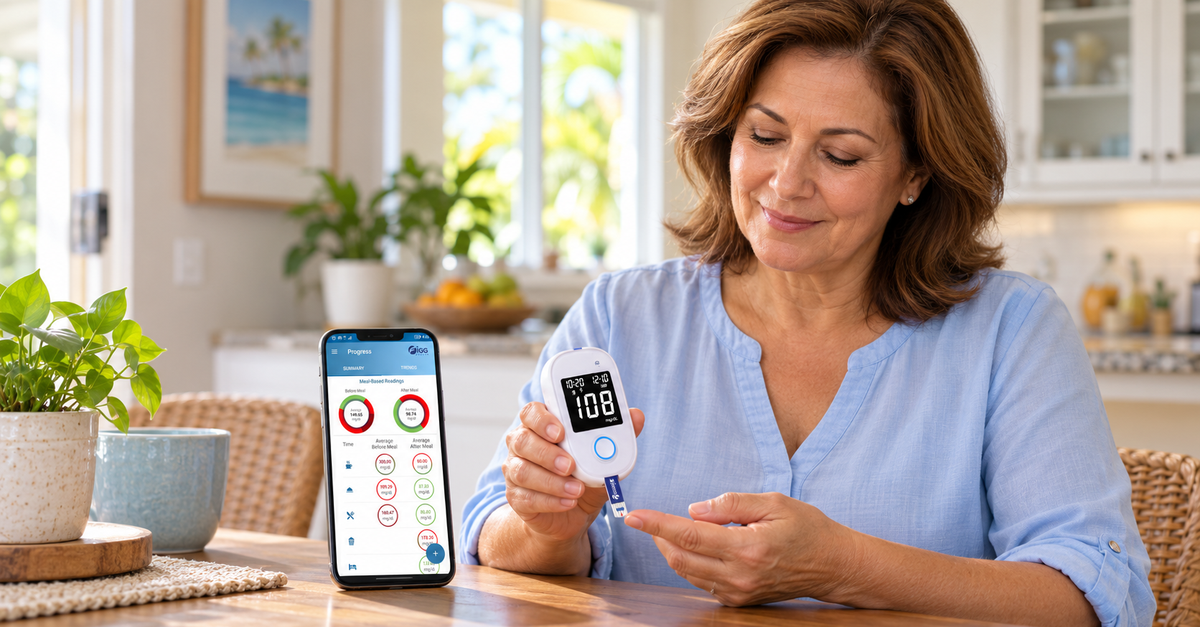
More than 2.1 million Florida adults live with diagnosed diabetes, and one in four residents aged 65 and older carries the diagnosis. FiggHealth, a healthcare technology company headquartered in Fort Lauderdale, designed its Smart Wireless Glucometer to turn each finger stick into a connected, time stamped record that patients, families and providers can act on. This article explains how the device and its companion platform work, what they cost, and why connected testing matters for diabetes care across Florida.
A blood glucose reading is only useful if someone sees it, understands it and does something with it. For decades the standard tool for home testing produced a number on a small screen, which the patient was expected to copy into a paper logbook and carry to the next appointment. Readings were missed, transcribed incorrectly or simply forgotten. FiggHealth built its Smart Wireless Glucometer to close that gap by connecting the meter to a secure cloud platform, a mobile application and a patient portal, so that every result is stored, charted and shared automatically.
The diabetes challenge in Florida
Diabetes is one of the largest chronic disease burdens in the state. According to the Florida Department of Health’s 2025 Florida Diabetes Advisory Council Legislative Report, the share of Florida adults diagnosed with diabetes rose from 8.2 percent in 2002 to 12.2 percent in 2022, above the national rate of 11.6 percent. The same report estimates that more than 2.1 million Florida adults have been diagnosed, with prevalence reaching 25.4 percent among adults aged 65 and older and 13.3 percent among adults aged 45 to 64. Another 11.1 percent of Florida adults reported being told they have prediabetes.
The burden is not evenly distributed. The report identifies Gadsden, Madison, Hamilton, Dixie, Putnam, Sumter, DeSoto, Highlands and Glades counties as areas where diabetes prevalence far exceeds the national average. Many of these are rural counties where the nearest endocrinologist can be an hour or more away. The economic cost is equally significant: the report cites an estimated $24.8 billion annual cost of diabetes in Florida, including $19.3 billion in direct medical expenses.
Monitoring blood glucose is one of the seven self care behaviors recognized by the Association of Diabetes Care and Education Specialists and referenced in the Florida report. The practical problem is that monitoring only improves care when the data reaches the people who can adjust medication, diet and activity. That is the problem FiggHealth set out to solve.
What the FiggHealth Smart Wireless Glucometer is
The FiggHealth Smart Wireless Glucometer is a rechargeable, portable blood glucose meter that pairs with the FiggHealth mobile application and the FiggHealth patient portal at patient.figg.health. The meter uses FiggHealth test strips built with eight sensors, which the company states deliver accurate results from a very small blood sample within seconds. Results appear on a large LED display without manual calibration codes, which removes one of the most common sources of error with older meters.
The device stores up to 500 results in its own memory and synchronizes them to the patient’s phone and to the cloud, where storage is unlimited. The meter recharges over a standard USB cable rather than relying on replaceable batteries, so patients can carry it for several days between charges.
The Starter Kit sold at figg.health includes the Smart Wireless Wellness Device, a lancing device, test strips, control solution, lancets, a USB charging cable, a travel case, a printed user manual and a logbook. FiggHealth lists replacement test strips at $10 per 50 strips with free shipping, and the company publishes its pricing openly on its website under its stated “People Over Profit” philosophy.
How the connected platform works
The value of the system is in what happens after the reading. The workflow has five steps.
- 1Test. The patient inserts a strip, applies a small blood sample and reads the result on the meter’s display in seconds.
- 2Synchronize. The meter transmits the reading, with a time stamp, to the FiggHealth app on the patient’s phone, which forwards it to the secure cloud.
- 3Log automatically. The digital logbook records the result alongside optional notes on food, exercise, medication and insulin, replacing the handwritten slip.
- 4Visualize. Color coded results show at a glance whether a reading falls within the patient’s target range, and charts show trends over days, weeks and months.
- 5Share. The patient can set family members or a healthcare provider to receive each reading automatically by SMS or email at no charge, or can export the full history as a CSV or PDF file for an appointment.
All shared information is password protected and transmitted over an encrypted channel, and the company states that the cloud system is designed to meet HIPAA privacy and security requirements. The app also lets patients configure SMS reminders for medications, insulin and scheduled glucose checks.
Why the technical design matters
Three design decisions distinguish the FiggHealth system from a standalone meter.
First, the eight sensor strip chemistry is intended to reduce the influence of common interferences and sample size variation, which are the leading causes of inconsistent home readings. Second, automatic time stamping and cloud synchronization remove transcription error entirely; the number the provider sees is the number the meter produced. Third, the contextual logbook ties each reading to the behavior around it. A reading of 180 mg/dL means something different after a large meal than it does on waking, and the infographics in the FiggHealth app are built to show that relationship so that patients and providers can see how medication changes, diet and activity are actually affecting glucose control.
For providers, the platform supports a different model of care. Instead of reviewing a logbook once every three months, a clinician who receives readings in real time can identify a pattern of overnight lows or post meal spikes within days and adjust the plan. The Florida Diabetes Advisory Council report notes that prompt feedback between provider and patient improves adherence and outcomes, and that telemedicine tools help remove barriers such as transportation. Connected glucose data is the foundation that makes that kind of responsive care possible.
Who benefits in Florida
- Patients with newly diagnosed type 2 diabetes or prediabetes who need to learn how their daily choices affect glucose without the burden of manual record keeping.
- Older adults, who represent the highest prevalence group in Florida, and who benefit from the large display, the absence of coding steps and the ability to have an adult child receive every reading automatically.
- Families supporting a relative in another city or county, who can be notified of an out of range result in time to call or visit.
- Primary care practices and federally supported health centers in rural counties, which can review exported histories or automated reports before and between visits.
- Uninsured and underinsured residents, for whom the openly published strip pricing and the no charge sharing, reminder and logbook services reduce the ongoing cost of self monitoring.
Verified details for readers
- Device: FiggHealth Smart Wireless Glucometer, rechargeable over USB, large LED display, no calibration codes.
- Strips: FiggHealth eight sensor test strips, listed at $10 per 50 strips with free shipping on figg.health.
- Memory: 500 results on the device; unlimited storage on the FiggHealth portal.
- Sharing: automatic SMS and email delivery of results to designated family members and providers at no charge; manual export in CSV and PDF formats.
- Access: FiggHealth app on Google Play; patient portal at patient.figg.health; provider refill ordering at figg.health/providerrefill.
- Support: 24 hour support at 1-800-391-2801.
Broader impact for the state
Florida’s diabetes strategy, as outlined in the 2025 legislative report, calls for promoting digital health tools and for ensuring that people with diabetes have access to the technologies that improve self management. A connected meter that is affordable, that records automatically and that shares results with the care team supports each of those goals. It also generates the kind of structured, longitudinal data that community health programs and diabetes self management education providers across Florida’s 67 counties can use to tailor coaching to each participant.
For a state with a large retiree population, extensive rural geography and a high diabetes burden, the practical advantage is straightforward: fewer missed readings, fewer transcription errors, earlier detection of dangerous patterns and a more informed conversation at every appointment.
Looking ahead
FiggHealth continues to develop the platform around its mission of improving the living standard of people with chronic conditions through technology. The glucometer and its companion services are available today to Florida residents through figg.health, and the same cloud infrastructure underpins the company’s remote patient monitoring platform for clinics and hospitals, which will be the subject of a separate FiggHealth newsroom article.
Florida residents who want to learn more about the Smart Wireless Glucometer, the Starter Kit or the FiggHealth patient portal can visit figg.health or call 1-800-391-2801. Healthcare providers interested in receiving patient readings or ordering supplies for their patients can visit figg.health/providerrefill.
About FiggHealth. FiggHealth Inc. is a healthcare technology company headquartered in Fort Lauderdale, Florida, operating under the motto People Over Profit. The company develops affordable, reliable and transparently priced products and services for people living with chronic conditions and for the providers who care for them, including the FiggHealth Smart Wireless Glucometer and a connected suite of clinical and operational platforms covering electronic health records, telehealth, remote patient monitoring, revenue cycle management, resource management and incident management. Learn more at figg.health or call 1-800-391-2801.
Published by FiggHealth Inc., Fort Lauderdale, Florida. FiggHealth Newsroom Editorial Team.